Showing posts with label Food. Show all posts

Wednesday, February 10, 2016

Kim Family Restaurant [ Lorong Kilat ]

Been to Kim Family Restaurant a few times but had never wrote anything about them and decide is time to 'do' something about it.

Was craving for something spicy and decided to go for their Triple Hotpot which looked red and spicy from the photo.

Triple Hotpot [ 곱창전골  ]

Triple Hotpot which is known as Gopchang jeongol [ 곱창전골 ] in Korea, is a kind of spicy stew or casserole made by boiling beef tripe, seasonings and vegetables in beef broth. Gopchang [ 곱창 ] refers to the small intestines of cattle. The dish is mainly based on gopchang [ 곱창 ] but other parts of beef tripe are also used so as to give the dish a richer flavor and a more chewy texture.

However, the triple hotpot ( Gopchang jeongol [ 곱창전골 ] ) in Kim Family Restaurant uses pig intestines instead of cattle.
The food arrived shortly and I was excited to get my first bite but still gonna wait patiently as the food got heat up and cooked.
When the food was finally cooked, I took a sip of the soup as I am very particular about the taste of the soup as I felt that the soup of a dish contains the flavor of all the ingredients of the dish and if the soup is not up to my expectation, I can consider giving the dish a miss.

The stew was quite diluted to my liking despite the amount of chilli and ingredients used for the dish. There was a slight smell and taste from the intestine which some people might not be used to it. The restaurant used beef in the dish and the beef was not chewy but yet it wasn't too tough. Most of the  ingredients in the dish taste separated just like their own individual flavor despite being cooked and boiled in the stew for a long time. However the Enokitake ( golden needle mushroom ) and the King Oyster Mushroom absorbed in the flavor of the intestine ended up that you will taste the gopchang [ 곱창 ] instead.

Personally, I will not order the dish again as I'm not a fan of intestine but ordered the dish as I wanna try something different and yet spicy at the same time. I was disappointed with my order as the dish wasn't spicy despite the stuff in the restaurant warned us that the dish is more on the spicy side. The dish was also too diluted as compared to other Korean dishes that I had eaten before.

However, to be fair too, I might considering trying out the dish again if I happened to come across it in Korea as my friends told me that even in Korea, due to the fact that the process of cooking and preparation can be tedious, so the dish is usually eaten in restaurants that are specialize in Gopchang jeongol [ 곱창전골 ].

Kimchi Hotpot Stew [ 김치전골 ]

Another dish that I tried recently is Kimchi Hotpot Stew [ 김치전골 ].

Kimchi Hotpot Stew [ 김치전골 ] is a category of elaborate stews in Korean cuisine and is similar to jjigae [ 찌개 ]. In the olden days, Jeongol [ 전골 ] was meant as a dish for the upper-class Koreans and also members of the royal courts while Jjigae [ 찌개 ] was more a simple dish for the commoners.

Kimchi Hotpot Stew [ 김치전골 ] of Kim Family Restaurant consists of clear noodles, tofu, pork, Enokitake ( golden needle mushroom ), zucchini and of course the main ingredients - Kimchi [ 김치 ].

Although the stew is red, but the taste of the stew is more sour rather than spicy due to the Kimchi [ 김치 ].As the kimchi was boiled in the stew for a long time, the kimchi was soft and suitable for people who are trying kimchi for the first time as most of the taste in the kimchi had been absorbed into the stew and the fermentation taste of the kimchi becomes more acceptable to all.

The ingredients had fully absorb the flavor and fragrance of the stew and the soup was thick with a sourish taste. Will recommended this dish for people who enjoy food that is more on the sour side but yet wanna try spicy food and is  unable to endure the burning sensation on your tongue and in your stomach after eating spicy food.
Do note that this dish contain clear noodle and is not necessary for you to order rice unless you are a big eater.

Do take note the portion for both dishes are quite large and is a shared dish. It can be shared among 2 to 4 people depending on how much your stomach can take in.

Kim Family Restaurant is located at:
17 Lorong Kilat
#01-06 Kilat Court
Singapore 598139

Tel :
6465 0535

Opening Hours :
Lunch :  12pm - 3pm
Dinner : 5.30pm - 10pm
Closed: Every 1st and 3rd Monday of the Month

Nearest MRT station:
Downtown line - Beauty World


Tuesday, June 16, 2015

Ming Jia @ Bukit Timah Plaza

Went for lunch at Ming Jia today. The eatery - Ming Jia that I am refering to is not the small little stall tucked away in the corner of Bukit Timah Plaza but a 'newly' opened stall located just beside WTS travel, right at the escalator.
This eatery is actually a sister shop of the original Ming Jia but has more food choices as compared to the original stall.

Was deciding in between common dishes that you can easily find at Korean restaurant or dishes not is not easily find in Korean restaurant in Singapore. Finally settled on a mixture of both.

Side dishes [ 반찬 ]

A common practice for Korean restaurant - side dishes are served while you are waiting for your meal. 
I love the salad and the kimchi [ 김치 ] of this eatery. The kimchi of this eatery is not as spicy as compared to kimchi of other Korean restaurant but I find it just right, as there are some kimchi that only carry the flavor of spiciness and nothing else. The kimchi of this eatery is spicy and yet you can taste the freshness of the vegetable at the same time. 
And they do sell the kimchi if you are interested in buying and the pricing is quite reasonable - $6 for about 500g of Kimchi. 

Kimchi Pancake [ 김치전 ] 

Kimchi Pancake [ 김치전 ], one of the most common dish that you can find easily in any Korean eatery. But people always say that food that is hardest to cook is usually the common dishes and if they are able to do the common dish well, it means that the food from the eatery is really delicious. 
Although this dish is named as Kimchi Pancake [ 김치전 ], but there are also squid in the pancake too. Ingredients used for the Kimchi Pancake [ 김치전 ] are quite generous as there are lots of squid used and you can say that every piece of the pancake contain one or two pieces of squid and it is consider a lot for a pancake that is suppose to contain nothing but Kimchi. The Kimchi Pancake [ 김치전 ] will have taste even better if the Kimchi Pancake [ 김치전 ] is a bit crispier. 

Totally recommended this dish if you are lookin for a side dish or just a snack and you happened to be a fan of Kimchi. Do note that the portion of the Kimchi Pancake [ 김치전 ] is enough for the serving for 3 to 4 people if you intend to order other food. 

Kimbap [ 김밥 ]

Kimbap [ 김밥 ], another popular and common dish that be seen easily in any Korean eatery in Korea but really hard to find in Singapore. Kimbap [ 김밥 ] is also known as sushi of Korea but there are some differences in sushi and Kimbap [ 김밥 ]. Sushi uses more of seafood and also vinegar in the rice but Kimbap [ 김밥 ] uses more of vegetables and sesame oil in the rice. Sushi are usually eaten cold but Kimbap [ 김밥 ] can be served at room temperature or even hot too. Personally, I feel that Kimbap [ 김밥 ] taste better than Sushi. ( No offence for Japanese food lover but this is just personal preference. ) 
However, it is really hard to find Kimbap [ 김밥 ] in Singapore, even in Korean eatery. I been searching for lots of Korean eatery to satisfy my craving for Kimbap [ 김밥 ] but usually I don't get my craving satisfied. I guess that the reason for the rareness of Kimbap [ 김밥 ] in Singapore is due to reason that the process of making Kimbap [ 김밥 ] can be quite tedious - the cutting of ingredients into strips, the boiling of the vegetables separately, the rolling of the Kimbap [ 김밥 ]. 

When I finally find Kimbap [ 김밥 ] in Ming Jia, I tell myself that it is a must to order. There are different choices for the Kimbap [ 김밥 ] on the menu - Vegetable Kimbap, Bulgogi Kimbap, Bacon Kimbap. Ordered the Bulgogi Kimbap but was told that they are no longer doing other choices for Kimbap [ 김밥 ] but only left with the original and common Kimbap which consists of various vegetables and ham. Decided to go for it as I really wanna get my craving satisfied. 
The Kimbap [ 김밥 ] was quite a big portion for the price of $8.90, and can easily feed two people. The kimbap was filled with lots of vegetables and you can really see that the ingredients are much more than the rice. The taste of sesame oil in the rice is quite strong with the additional glaze of sesame oil on the seaweed makes it even stronger. So for people who do not like the smell or even taste of sesame oil can just consider skipping the dish. 

Jjampong ( Spicy Seafood Noodle ) [ 짬뽕 ]

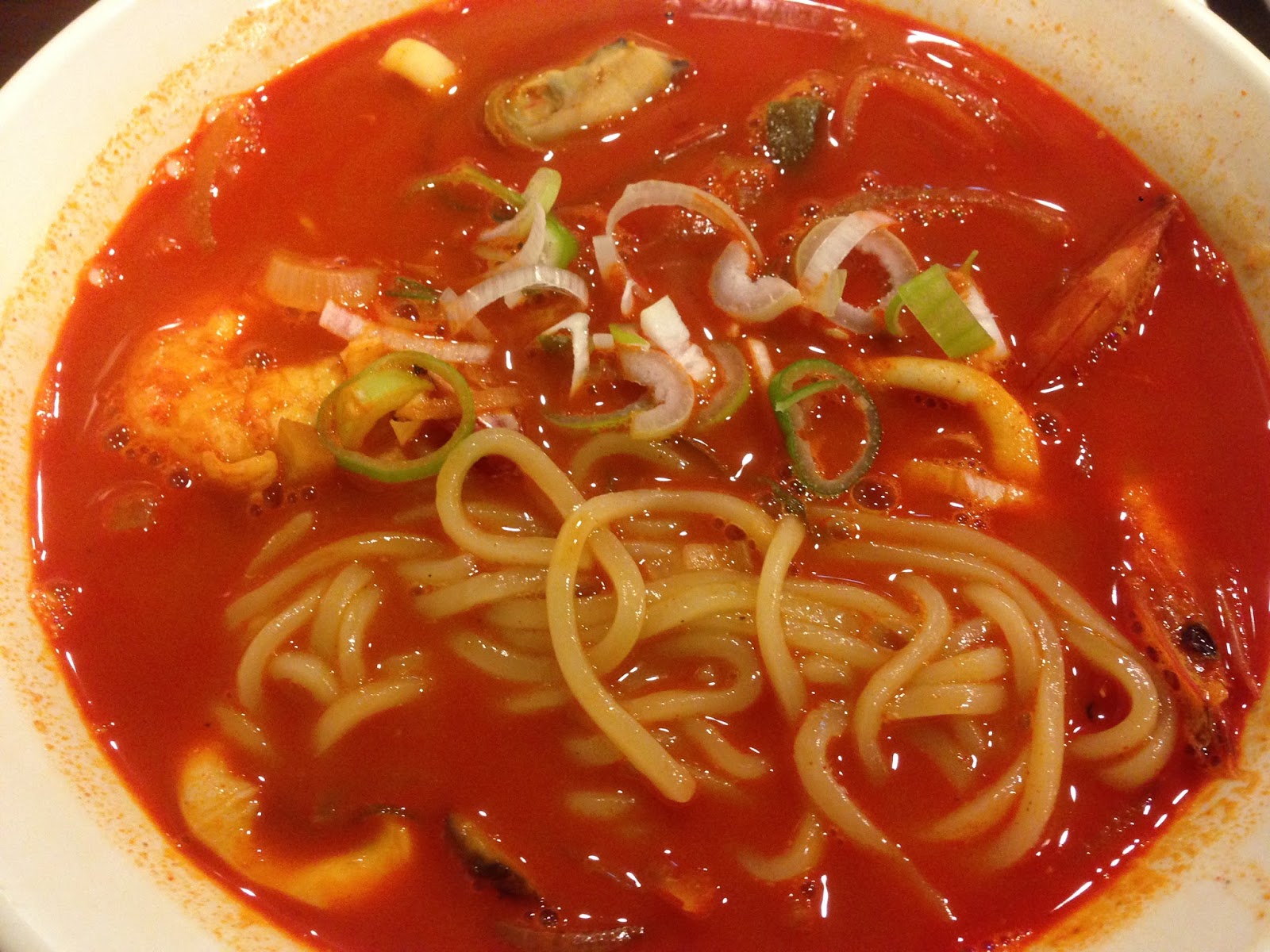
Last but not least, we ordered Jjampong ( Spicy Seafood Noodle ) [ 짬뽕 ]. Jjampong [ 짬뽕 ] is a Korean Chinese cuisine that is derived from traditional Chinese cuisine but has been locally influenced by local ingredients in Korea. Jjampong [ 짬뽕 ] can be easily find in Korean Chinese restaurants and certain Korean eatery too. This is also another dish that is not commonly find in Korean eatery in Singapore. 

The appearance of the Jjampong [ 짬뽕 ] seemed to be spicy from the colour of the soup, but looks could be deceiving. The soup didn't taste as hot and fiery as I was expecting. The spiciness doesn't linger in your mouth and can be easily be washed off with water if you find it too spicy. Mussels, squids and prawn were used in the cooking of the Jjampong [ 짬뽕 ] thus u could taste sweetness from the seafood. It could have been better if the soup can be more zesty and the taste can linger in your mouth instead of come and go. 
However, I really love the texture of the noodle. The noodle was chewy, soft and tender but yet it didn't have the unpleasant texture that most overcooked noodles have. 
Will recommended this dish if you are looking for a different kind of noodle that carries the different taste of Korea. 


The eatery can be easily spotted. It is just located beside WTS travel at level B1. However, do take note of the opening hours :

12pm - 4.30pm
6.00pm - 10pm
( Do note that the opening hours for dinner can varies according to the eatery too. ) 


Tuesday, December 23, 2014

Korea Trip Day 8 [ 한국여행 - 여덟째날 ]

Went on a historical experience today. But before we officially go on the historical journey, we had to get our stomach filled. 

Random walked passed this Korean restaurant and decided to went in for our brunch. 


The entrance of the restaurant

We ordered a stir fried spicy octopus and chicken [ 쭈&닭철판볶음 ]. The food was served shortly after we had ordered our food. 

The side dishes [ 반찬 ] from the restaurant 

Five-grain [ 오곡밥 ] rice was served instead of white rice

Stir fried spicy octopus and chicken [ 쭈&닭철판볶음 ]

The Stir fried spicy octopus and chicken [ 쭈&닭철판볶음 ] was rather sweet at the first taste and it started to get spicy as you continued to eat. The octopus was chewy and not too hard as it was not overcooked and the chicken was rather sweet and spicy at the same time after absorbing the sauce into the meat, and yet the meat is at the same time. 
The boss of the shop was helpful and kept on coming over to our table to ensure that the food was not overcooked or burnt. He even added our rice into the sauce and told us to eat it that way so that the rice will be tastier. He add in sesame oil and seaweed to the rice and keep on saying: delicious.

Set off to  Namsangol Hanok Village [ 남산골한옥마을 ] after lunch. 

Namsangol Hanok Village [ 남산골한옥마을 ] which is also known as the village of traditional houses. The Korean traditional houses known as Hanok [ 한옥 ] have been restored to preserve the original atmosphere of that area. 
Namsangol Hanok Village [ 남산골한옥마을 ] consists of a collection of 5 Hanok [ 한옥 ] which were recovered from different parts of the city and relocated to Namsangol Hanok Village [ 남산골한옥마을 ]. Namsangol Hanok Village [ 남산골한옥마을 ] allows you to experience the Joseon dynasty citizenry and activities, from royalty to commoners. 


Main gate of Namsangol Hanok Village [ 남산골한옥마을 ] 

One of the Hanok [ 한옥 ]


A place where kimchi is stored 


Kitchen utensils


Pots for storing Kimchi

You can easily spend about 2 hours at Namsangol Hanok Village [ 남산골한옥마을 ] by visiting the different classes of Hanok [ 한옥 ]. There are also furniture being placed in the different rooms to let you have a better understanding of daily life during the Joseon dynasty. 

After touring the Namsangol Hanok Village [ 남산골한옥마을 ], you go also take part in the traditional Korean activities or games such as archery, Korean traditional dance and music and much more. During the weekends, Korean traditional marriage ceremony are shown at the Bak Yeong Hyo's residence and the ceremony is usually held at noon or 1pm. So do stay and watch the ceremony if you are visiting Namsangol Hanok Village [ 남산골한옥마을 ] during weekend. 

How to go to Namsangol Hanok Village [ 남산골한옥마을 ] :
Chungmuro Station ( 충무로 역 ), Line 3 or 4 [ 3/4호선 ] Exit 4 [ 4번 출구 ]

Other Information
Admission : Free
Closed on every Tuesday
Opening Hours : 
April - Oct : 9am - 9pm
Nov - Mar : 9am - 8pm

Final photo before setting off for Gyeongbokgung [ 경복궁 ]

Let's move on to the next stop : Gyeongbokgung [ 경복궁 ]

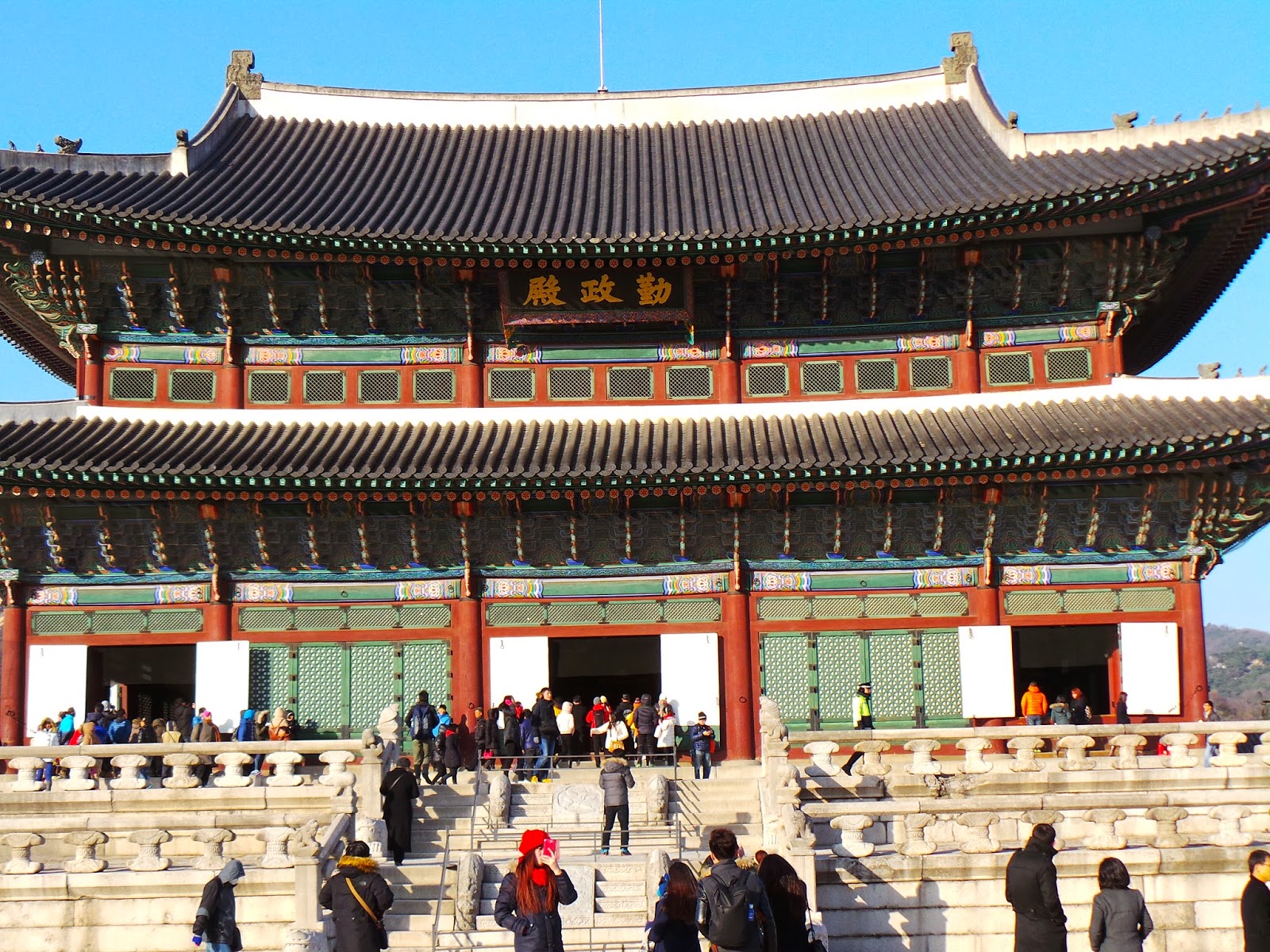
Gyeongbokgung [ 경복궁 ] is the main and the largest of the five grand palaces built by the Joseon Dynasty. It was built in 1395 ( 3 years after the Joseon Dynasty was found ) and served as the home for the kings of the Joseon Dynasty. 

The palace continued to serve as the main palace until Japanese invasions of Korea ( 1952 - 1598 ), when all of the palaces were damaged. The palace was abandoned for 2 centuries and was only restored and reconstructed under the leadership of Price Regent Heungseon [ 흥선대원군 ] during the reign of King Gojong [ 고종 광무제 ]. 
Gyeongbokgung [ 경복궁 ] flourished for several decades until the Japanese once again demolished the palaces during the Japanese occupation ( 1910 - 1945 ). 

Heungnyemun, The second inner gate of Gyeongbokgung [ 경복궁 ]

The Korean government has been putting in effort since 1990, trying to restore and rebuild the building that were destroyed during the Japanese occupation. Although only about 40% of the buildings have been restored, but there are still lot of beautiful things to see in the palace. 

Geunjeongjeon [ 근정전 ] ( Imperial Throne Hall )

Geunjeongjeon [ 근정전 ] interior

Gyeonghoeru [ 경회루 ] ( The Royal Banquet Hall )

Beside taking a tour and looking at the different buildings in the palace, the reenactment of the changing of the Royal Guard and the Patrol Ritual are performed daily from 10am to 3pm, in front of the second inner gate of Gyeongbokgung [ 경복궁 ] - Heungnyemun.


Do stay for the reenactment of the changing of the Royal Guard and the Patrol Ritual if you have a chance as the ceremony is quite grand and it last for about 10 minutes, giving you the chance to take lots of photos of the ceremony. 

How to go to Gyeongbokgung [ 경복궁 ] :
Gyeongbokgung Palace Station [ 경복궁 역 ], Line 3 [ 3호선 ], Exit 5 [ 5번 출구 ]
or
Gwanghwamun Station [ 광화문 역 ], Line 5 [ 5호선 ], Exit 2  [ 2번 출구 ]

Other Information
Admission : 3000won
Closed on every Tuesday
Opening Hours :
Nov - Feb : 9am - 5pm
Mar - May and Sept - Oct : 9am - 6pm
Jun - Aug : 9am - 6.30pm 
Last admission : 1hr before closing

This day allow me to understand the different classes of Joseon Dynasty, from the royalty to commoners. It also leave me in awe of how the Korean government is making an effort to preserve such historical sites so that the future generation can have a better understanding and also a chance to view the past. 
It also make me wonder about the history of the other dynasty such as the Silla dynasty, the Goryeo dynasty and much more. I hope that I have the chance to find out more about the histories of the other dynasty in the future. 

Thursday, December 4, 2014

Korea Trip Day 6 [ 한국여행 - 여섯째날 ]

Seoul, the capital of South Korea has a combination of historical and modern sight seeing places. There are 5 palaces in Seoul and i made a trip down to Unhyeonggung [ 운현궁 ] today.

Unhyeonggung [ 운현궁 ] is also known as the Royal Residences. Unhyeonggung [ 운현궁 ] was formerly the residence of King Gojong [ 고종 ] before enthroned. Unhyeonggung [ 운현궁 ]  also served as a private residence of Prince Regent Heungseon [ 흥선대원군 ] ( Father of King Gojong [ 고종 ] ).
Unhyeonggung [ 운현궁 ] today is a much more smaller than the majestic structure that it used to be due to the damaged during the Japanese colonial period and the Korean War.

Unhyeonggung [ 운현궁 ] is split into 4 main structures - Norakdang Hall ( Largest building in the palace and also the wedding site for King Gojong [ 고종 ] and Queen Myeongseong [ 명성황후 ]. It also served as one of two residence area for women ), Noandang Hall ( A place where Prince Regent Heungseon [ 흥선대원군 ] received his guest and also a leisure quarter for the men ), Irodang Hall ( Residence area for women ), Sujiksa ( Housing for servants and guards ).

The entrance of Unhyeonggung [ 운현궁 ]

After entering the main gate of Unhyeonggung [ 운현궁 ]

After entering the main gate, located on the left, there is a traditional house that will lead you to the exhibition hall of the remains. 

The 'house' where the exhibition is 

In the exhibition room, you can learn about the clothing that were wore during the wedding ceremony, the scripts, bowls, head gears and much more that were used in the past. There is also some introduction boards about the history so that you can have a better understanding. 

Costume wore during the wedding ceremony

A book to record the farm's belonging 

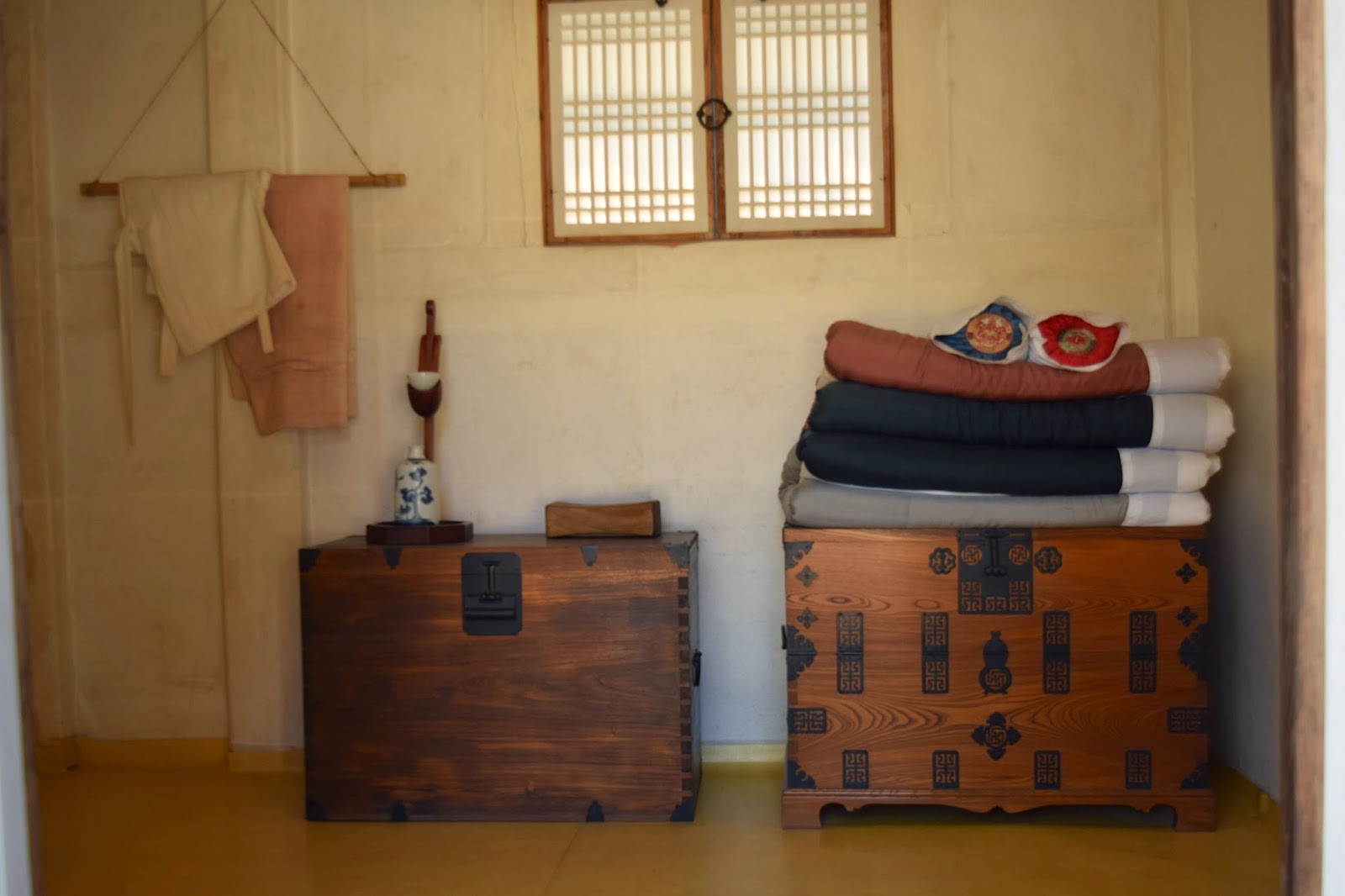
After exiting from the exhibition hall, you can continue your journey by exploring the 4 main structures of Unhyeonggung [ 운현궁 ]. The structures are quite similar, but the interesting part of Unhyeonggung [ 운현궁 ] is that the rooms are opened up for visitors to view the display and furniture used in the past. 

Display of the kitchen

The court ladies preparing food

Queen Myeongseong [ 명성황후 ] celebrating the birthday of King Gojong [ 고종 ]'s mother

Furniture used in the past

One of the corridor 

I feel that it is an interesting place to visit as the displays, and the construction allows me to have a better understanding of the Joseon dynasty, on how the Royal families lived and the things that they used. 

Do note that the reenactment of King Gojong [ 고종 ] and Queen Myeongseong [ 명성황후 ] wedding will take places during spring and fall every year. It's a pity that I do not get to see the reenactment of the wedding this year, but I'm quite sure that I will be back to visit Seoul again and hopefully I will get to see the reenactment of the wedding then.  

How to get to Unhyeonggung [ 운현궁 ] :
Take the subway to Anguk Station [ 안국역 ], Line 3 [ 3 호선 ], Exit 4 [ 4번 출구 ].
50m from the station 

Admission : Free


After Unhyeonggung [ 운현궁 ], we went down to Bukchon Hanok Village [ 북촌한옥마을 ]. While on our way, we were hungry and drop by at this restaurant for our lunch. I was surprised by the pricing of the abalones and dishes of this restaurant as they were really cheap ( as compared to Singapore ), so Nurfa and I decided to have our lunch here. 

The outlook of the restaurant 


Close up of a sea creature( Not sure what is it though )

Most of the dishes in this restaurant has abalone added to it, but if you are those one of the few people who don't eat abalone, there are still some choices of normal korean food.  I ordered a Abalone Bean Paste Soup [ 전복 된장찌개 ].  

The side dishes served in the restaurant

The kimchi served in this restaurant tasted really nice and it was different from the kimchi from other restaurant. There is a taste of peanut and sesame seed in the chilli but we don't seem to find any trace of peanut in the chilli. The chilli also tasted different from other restaurant and it actually makes you crave for more. I finished almost the whole plate of the kimchi. 

Abalone Bean Paste Soup [ 전복 된장찌개 ]

The soup was served boiling and sizzling hot. There were quite a lot of ingredients in the soup - tofu, clams, onions, zucchini, golden needle mushroom and more, and of course not to forget, there were 2 abalones inside. The soup did not taste too salty although there is a strong smell of the Bean Paste [ 된장 ] and yet tasting a little spicy at the same time. The vegetables inside the soup was soft and tasted fresh and sweet. The clams and the abalones were a pity as it was not easy eating them as I was using chopsticks and trying to separate the meat from the shells. 
Overall, I still enjoyed my meal and guess what....it only cost 9000won ( about SGD11 ) for the a dish that consists of abalone....Where to get that in Singapore???

Direction to the restaurant :
Take the subway to Anguk Station [ 안국역 ], Line 3 [ 3 호선 ], Exit 2 [ 2번 출구 ].
Continue to walk straight after you reached the information booth for Bukchon Hanok Village [ 북촌한옥마을 ]. You will see the restaurant not long after passing the information booth. 


Finally we arrived at Bukchon Hanok Village [ 북촌한옥마을 ]. Bukchon Hanok Village [ 북촌한옥마을 ] is a traditional village which is located in between Gyeongbokgung [ 경복궁 ] and Changdeokgung [ 창덕궁 ]. It is also the home to about 900 traditional houses which is also known as Hanok. 

Bukchon Hanok Village [ 북촌한옥마을 ] was not designed to be a tourist area but more for a residence area, thus there are still many hanoks for residence purpose. However, some of the hanoks have been converted to shops, restaurants, guesthouse ( for people to experience staying in hanok ) and even a place whereby people can get to experience the traditional crafts. 

Bukchon Hanok Village [ 북촌한옥마을 ] is also famous for filming location site. Dramas such as Heartstring [ 넌 내게 반했어 ], Personal Taste [ 개인의 취향 ] and many other dramas. 

One of the many steep slopes in Bukchon Hanok Village [ 북촌한옥마을 ]

One of the alley 

Traditional house - Hanok

A drawing on the wall found by accident

Walking in Bukchon Hanok Village [ 북촌한옥마을 ] can be quite confusing and tiring as there are many alleys in the area and you might get lose if your sense of direction is not good or you might get confused, thinking if you had visited that area before as the hanoks look similar. And also there are a lot of steep slopes in Bukchon Hanok Village [ 북촌한옥마을 ], so your whole walking tour will consider of climbing up the slopes and going down slopes again. So be prepared and wear comfortable shoes. 

I do consider Bukchon Hanok Village [ 북촌한옥마을 ] a great place to visit as you can see the traditional houses dated to Joseon dynasty and it can be amazing to think about how these houses can be preserved and also well maintained at the same time. 

Another thing to take note of while you are exploring Bukchon Hanok Village [ 북촌한옥마을 ], always remember this is an residence area so always keep your volume down. There are banners everywhere to remind people of this simple rule but yet I met a number of people/groups that did not seem to understand what is the meaning of silence. I felt frustrated seeing such behaviours, let alone the people staying there. 

Photo taken from the top of Bukchon Hanok Village [ 북촌한옥마을 ]

Roofs of the Hanoks taken from the top 

The faraway mountain photo taken from the top of Bukchon Hanok Village [ 북촌한옥마을 ]


Direction to the Bukchon Hanok Village [ 북촌한옥마을 ] :
Take the subway to Anguk Station [ 안국역 ], Line 3 [ 3 호선 ], Exit 2 [ 2번 출구 ].
Go straight for about 300m


After a day of tour at the different historical sites, we decided to have a chance of atmosphere by visiting Hongdae [ 홍대 ]. Hongdae [ 홍대 ] is famous for its urban arts, indie music cultures and night life. With the different musical events, street performances going on in Hongdae [ 홍대 ], the streets are always full and packed with lots of people. 

Hongdae [ 홍대 ] is also a well-known university area, so there are lots of shops with cheap and reasonable pricing catered for the university student. If you are not those kind of people that go for night life, you can always drop by Hongdae [ 홍대 ] for the choices of restaurants and to shop around the street.

( Credits to https://itgoessuwonandon.wordpress.com/2012/09/16/hello-hongdae/ )

Direction to the Hongdae [ 홍대 ] :
Take the subway to Hongik University Station [ 홍대입구역 ], Line 2 [ 2 호선 ], Exit 9 [ 9번 출구 ].


It is definitely one of itinerary to consider if you are on a trip in Seoul, to experience the youthful atmosphere in Hongdae [ 홍대 ].