Thursday, December 4, 2014

Korea Trip Day 6 [ 한국여행 - 여섯째날 ]

Seoul, the capital of South Korea has a combination of historical and modern sight seeing places. There are 5 palaces in Seoul and i made a trip down to Unhyeonggung [ 운현궁 ] today.

Unhyeonggung [ 운현궁 ] is also known as the Royal Residences. Unhyeonggung [ 운현궁 ] was formerly the residence of King Gojong [ 고종 ] before enthroned. Unhyeonggung [ 운현궁 ]  also served as a private residence of Prince Regent Heungseon [ 흥선대원군 ] ( Father of King Gojong [ 고종 ] ).
Unhyeonggung [ 운현궁 ] today is a much more smaller than the majestic structure that it used to be due to the damaged during the Japanese colonial period and the Korean War.

Unhyeonggung [ 운현궁 ] is split into 4 main structures - Norakdang Hall ( Largest building in the palace and also the wedding site for King Gojong [ 고종 ] and Queen Myeongseong [ 명성황후 ]. It also served as one of two residence area for women ), Noandang Hall ( A place where Prince Regent Heungseon [ 흥선대원군 ] received his guest and also a leisure quarter for the men ), Irodang Hall ( Residence area for women ), Sujiksa ( Housing for servants and guards ).

The entrance of Unhyeonggung [ 운현궁 ]

After entering the main gate of Unhyeonggung [ 운현궁 ]

After entering the main gate, located on the left, there is a traditional house that will lead you to the exhibition hall of the remains. 

The 'house' where the exhibition is 

In the exhibition room, you can learn about the clothing that were wore during the wedding ceremony, the scripts, bowls, head gears and much more that were used in the past. There is also some introduction boards about the history so that you can have a better understanding. 

Costume wore during the wedding ceremony

A book to record the farm's belonging 

After exiting from the exhibition hall, you can continue your journey by exploring the 4 main structures of Unhyeonggung [ 운현궁 ]. The structures are quite similar, but the interesting part of Unhyeonggung [ 운현궁 ] is that the rooms are opened up for visitors to view the display and furniture used in the past. 

Display of the kitchen

The court ladies preparing food

Queen Myeongseong [ 명성황후 ] celebrating the birthday of King Gojong [ 고종 ]'s mother
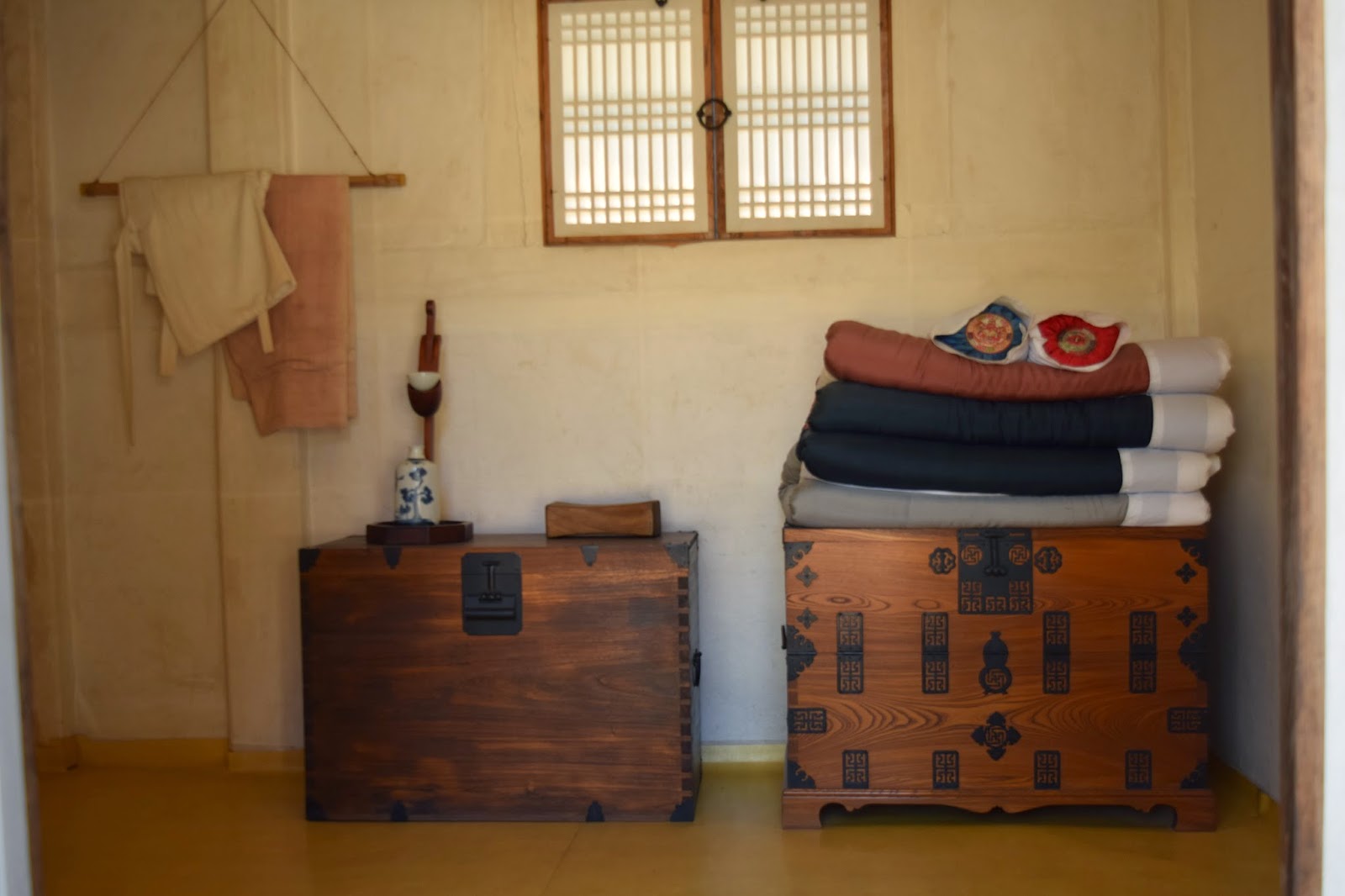
Furniture used in the past

One of the corridor 

I feel that it is an interesting place to visit as the displays, and the construction allows me to have a better understanding of the Joseon dynasty, on how the Royal families lived and the things that they used. 

Do note that the reenactment of King Gojong [ 고종 ] and Queen Myeongseong [ 명성황후 ] wedding will take places during spring and fall every year. It's a pity that I do not get to see the reenactment of the wedding this year, but I'm quite sure that I will be back to visit Seoul again and hopefully I will get to see the reenactment of the wedding then.  

How to get to Unhyeonggung [ 운현궁 ] :
Take the subway to Anguk Station [ 안국역 ], Line 3 [ 3 호선 ], Exit 4 [ 4번 출구 ].
50m from the station 

Admission : Free


After Unhyeonggung [ 운현궁 ], we went down to Bukchon Hanok Village [ 북촌한옥마을 ]. While on our way, we were hungry and drop by at this restaurant for our lunch. I was surprised by the pricing of the abalones and dishes of this restaurant as they were really cheap ( as compared to Singapore ), so Nurfa and I decided to have our lunch here. 

The outlook of the restaurant 


Close up of a sea creature( Not sure what is it though )

Most of the dishes in this restaurant has abalone added to it, but if you are those one of the few people who don't eat abalone, there are still some choices of normal korean food.  I ordered a Abalone Bean Paste Soup [ 전복 된장찌개 ].  

The side dishes served in the restaurant

The kimchi served in this restaurant tasted really nice and it was different from the kimchi from other restaurant. There is a taste of peanut and sesame seed in the chilli but we don't seem to find any trace of peanut in the chilli. The chilli also tasted different from other restaurant and it actually makes you crave for more. I finished almost the whole plate of the kimchi. 

Abalone Bean Paste Soup [ 전복 된장찌개 ]

The soup was served boiling and sizzling hot. There were quite a lot of ingredients in the soup - tofu, clams, onions, zucchini, golden needle mushroom and more, and of course not to forget, there were 2 abalones inside. The soup did not taste too salty although there is a strong smell of the Bean Paste [ 된장 ] and yet tasting a little spicy at the same time. The vegetables inside the soup was soft and tasted fresh and sweet. The clams and the abalones were a pity as it was not easy eating them as I was using chopsticks and trying to separate the meat from the shells. 
Overall, I still enjoyed my meal and guess what....it only cost 9000won ( about SGD11 ) for the a dish that consists of abalone....Where to get that in Singapore???

Direction to the restaurant :
Take the subway to Anguk Station [ 안국역 ], Line 3 [ 3 호선 ], Exit 2 [ 2번 출구 ].
Continue to walk straight after you reached the information booth for Bukchon Hanok Village [ 북촌한옥마을 ]. You will see the restaurant not long after passing the information booth. 


Finally we arrived at Bukchon Hanok Village [ 북촌한옥마을 ]. Bukchon Hanok Village [ 북촌한옥마을 ] is a traditional village which is located in between Gyeongbokgung [ 경복궁 ] and Changdeokgung [ 창덕궁 ]. It is also the home to about 900 traditional houses which is also known as Hanok. 

Bukchon Hanok Village [ 북촌한옥마을 ] was not designed to be a tourist area but more for a residence area, thus there are still many hanoks for residence purpose. However, some of the hanoks have been converted to shops, restaurants, guesthouse ( for people to experience staying in hanok ) and even a place whereby people can get to experience the traditional crafts. 

Bukchon Hanok Village [ 북촌한옥마을 ] is also famous for filming location site. Dramas such as Heartstring [ 넌 내게 반했어 ], Personal Taste [ 개인의 취향 ] and many other dramas. 

One of the many steep slopes in Bukchon Hanok Village [ 북촌한옥마을 ]

One of the alley 

Traditional house - Hanok

A drawing on the wall found by accident

Walking in Bukchon Hanok Village [ 북촌한옥마을 ] can be quite confusing and tiring as there are many alleys in the area and you might get lose if your sense of direction is not good or you might get confused, thinking if you had visited that area before as the hanoks look similar. And also there are a lot of steep slopes in Bukchon Hanok Village [ 북촌한옥마을 ], so your whole walking tour will consider of climbing up the slopes and going down slopes again. So be prepared and wear comfortable shoes. 

I do consider Bukchon Hanok Village [ 북촌한옥마을 ] a great place to visit as you can see the traditional houses dated to Joseon dynasty and it can be amazing to think about how these houses can be preserved and also well maintained at the same time. 

Another thing to take note of while you are exploring Bukchon Hanok Village [ 북촌한옥마을 ], always remember this is an residence area so always keep your volume down. There are banners everywhere to remind people of this simple rule but yet I met a number of people/groups that did not seem to understand what is the meaning of silence. I felt frustrated seeing such behaviours, let alone the people staying there. 

Photo taken from the top of Bukchon Hanok Village [ 북촌한옥마을 ]

Roofs of the Hanoks taken from the top 

The faraway mountain photo taken from the top of Bukchon Hanok Village [ 북촌한옥마을 ]


Direction to the Bukchon Hanok Village [ 북촌한옥마을 ] :
Take the subway to Anguk Station [ 안국역 ], Line 3 [ 3 호선 ], Exit 2 [ 2번 출구 ].
Go straight for about 300m


After a day of tour at the different historical sites, we decided to have a chance of atmosphere by visiting Hongdae [ 홍대 ]. Hongdae [ 홍대 ] is famous for its urban arts, indie music cultures and night life. With the different musical events, street performances going on in Hongdae [ 홍대 ], the streets are always full and packed with lots of people. 

Hongdae [ 홍대 ] is also a well-known university area, so there are lots of shops with cheap and reasonable pricing catered for the university student. If you are not those kind of people that go for night life, you can always drop by Hongdae [ 홍대 ] for the choices of restaurants and to shop around the street.

( Credits to https://itgoessuwonandon.wordpress.com/2012/09/16/hello-hongdae/ )

Direction to the Hongdae [ 홍대 ] :
Take the subway to Hongik University Station [ 홍대입구역 ], Line 2 [ 2 호선 ], Exit 9 [ 9번 출구 ].


It is definitely one of itinerary to consider if you are on a trip in Seoul, to experience the youthful atmosphere in Hongdae [ 홍대 ].

Tuesday, December 2, 2014

Korea Trip Day 5 [ 한국여행 - 다섯째날 ]

Decide to make a day trip to Ganghwado [ 강화도 ] today. The moment we stepped out from our accommodation, a pleasant surprise was waiting for us. It was snowing.

Trying to take a picture with snow effect

After taking enough pictures of snow, we set off and make our way to Ganghwado [ 강화도 ].

Ganghwado [ 강화도 ] is the fifth largest island of Korea and is located in the West sea. Because there were many people living in Ganghwado [ 강화도 ] in the prehistoric times, many ancient stuff can be seen and found on the island.  

How to get to Ganghwado [ 강화도 ] :
Take the subway to Sinchon Station [ 신촌 역 ], Line 2 [ 2 호선 ], Exit 1 [ 1번 출구 ].

Walk straight for about 5 minutes towards the GS25 convenience store. 
Take Bus 3000 to Ganghwa Intercity Bus Terminal. 
( Bus schedule: 05:40-23:20, 15-20min intervals) 

Note : 
The announcement of the bus stations are in Korean but you just have to take to the final stop. 
The journey will take about 1.5hour

We finally reached our destination after a long and bumpy ride.

The bus terminal

Waiting area of buses 

The moment we alighted from the bus, we can feel the strong wind blowing and we quickly entered the building located next to the terminal. Inside the building, there were stalls selling shoes, clothes, army stuffs etc. 

We exited the building and hoping to find a place to have our lunch. Walking along the main street, we don't seem to see any place that sell food. The wind was really strong and it seemed that the wind is trying to blow us away. Trying to fight against the wind and also finding a eatery at the same time was a torture.
We finally found a cafe and quickly entered the cafe to avoid the strong wind. 

Counter of the cafe

Interior of the cafe

Chocolate mint latte and cheese sandwich

We sat in the cafe, trying to figure out the way to go. The cashier in the cafe was so nice to help us researched on the way to get to our destination. We were told that although Ganghwado [ 강화도 ] is a small island but it is still quite impossible to walk to each destination as it would take a really long time.

We went off to explore Ganghwado [ 강화도 ]. The island is an interesting island as you can see lots of shops that are old but yet they had many choices for each individual shops. 
We continued walking but found it really too cold and the wind was so strong that things such as cardboard and plastic were flying around.

Even a metal pole couldn't take the wrong wind

As I walked around the island, I noticed that most of the building in Ganghwado [ 강화도 ] were old and short building. There were also a lot of constructions going on in the island, but yet there were also a lot of grounds that were undeveloped yet. 


After about a two hours walk, we really couldn't take it anymore that we decided to escape back to Seoul. The wind was blowing right into my face and this is the first time that I'm experiencing pain in my ears due to the cold chilly weather. 
We quickly made our way back to the building that is located next to the bus terminal. We dropped by an eatery and I had Seolleongtang [ 설렁탕 ] for lunch and to warm myself up. 

Seolleongtang [ 설렁탕 ], or also known as ox bone soup. Seolleongtang [ 설렁탕 ] is usually make from cow's bone, brisket and other cuts, thus the soup is rich in proteins and calcium. Seolleongtang [ 설렁탕 ] is inexpensive and is very popular with Koreans.

Local eatery 

Seolleongtang [ 설렁탕 ]

We took the bus 3000 and went on another bumpy 1.5hour ride. On the way back from Ganghwado [ 강화도 ], there were beautiful scenery along the road.


Although we only managed to survive 2hours at Ganghwado [ 강화도 ], but I would love to return to the island again one day to explore the historical stuff on the island. But I guess any other season beside winter would be better choice. 

After returning to Seoul, we went to Dongdaemun [ 동대문 ] and visited Yong at Irene's mum shop. Thanks to Yong, I experienced food delivery in Korean. Yong ordered Korean Chinese style food [ 중화요리 ] which is the the famous Korean Jajangmyeong [ 자장면 ] and Tangsuyuk [ 탕수육 ] ( Sweet and sour pork/chicken ). 

Jajangmyeong [ 자장면 ] was chewy and and not too salty. There were a lot of ingredients with the noodles such as different types of mushrooms and lots of onions. 
Tangsuyuk [ 탕수육 ] was crispy and not too soft although the meat was cut into big pieces. Dried chilli were used to add on some spice to the dish. The sauce was sweet and spicy at the same time, giving you the pleasant of 2 kinds of different tastes in a dish. 

Went back to our accommodation after dinner as it was really too cold to continue exploration. Hopefully the weather will be better tomorrow. 

Monday, December 1, 2014

Korea Trip Day 4 [ 한국여행 - 넷째날 ]

Met up With Irene and Yong today and they brought us to Samcheongdong [ 삼청동 ] for lunch.

Samcheongdong [ 삼청동 ], a place where the traditional and modern meet. In Samcheongdong [ 삼청동 ], it is very common to see restaurants of traditional design and next to these traditional building, cafes or shops of the modern design can be seen.

Restaurants with 'old' houses as the background

Traditional and modern meets

Directions to Samcheongdong [ 삼청동 ] :
Anguk Station [ 안국역 ] , Line 3 [ 3 호선 ] , Exit 1 [ 1번 출구 ]

Irene and Yong brought us to this eatery which is famous for Sujebi [ 수제비 ]. Sujebi [ 수제비 ] which is also commonly known as hand-torn noodles soup. Irene told us that Koreans will commonly consume Sujebi [ 수제비 ]on rainy days. 

Sujebi [ 수제비 ] is a traditional Korean soup considering dough flake torn by hand, with various vegetable. The taste of Sujebi [ 수제비 ] is very similar to Kalguksu [ 칼국수 ], except that Kalguksu [ 칼국수 ] is made with noodles instead.

The soup of Sujebi [ 수제비 ] is usually made with dried anchovies, shellfish and these ingredients are simmered for hours. Various vegetable such as potato, onions and zucchini are added to the soup.

The shop that is famous for Sujebi [ 수제비 ]

We ordered potato pancake [ 감자전 ] and Sujebi [ 수제비 ]. The dishes were served quickly which I guess that the eatery hope that we can quickly finished our meal so that more people can entered the eatery as there was a long queue outside despite it is already way pass lunchtime. 

Potato pancake [ 감자전 ]

Sujebi [ 수제비 ] being served in a pot

Sujebi [ 수제비 ]

Directions to the eatery :
Anguk Station [ 안국역 ] , Line 3 [ 3 호선 ] , Exit 1 [ 1번 출구 ]
Walk straight down the main street of Samcheongdong [ 삼청동 ], and the eatery is located somewhere in the middle of the main street, on the left.

Just outside the eatery

We saw a rainbow the moment we stepped out of the eatery and we were told by Irene and Yong that we were really lucky as rainbow is not common in Seoul. We continued our exploration of Samcheongdong [ 삼청동 ] after lunch. 


Real human as mannequin 

Beautiful art piece on the wall

We continue walking into an alley in Samcheongdong [ 삼청동 ] and there were more shops selling stuff as compared to the main street of Samcheongdong [ 삼청동 ]. I found that there were more restaurants and cafes on the main street. 

A shop selling ddeokbokki [ 떡볶이 ]

We continued to walk and after about 15min, we arrived at Insadong [ 인사동 ]. Did not know that Insadong [ 인사동 ] is so near to Samcheongdong [ 삼청동 ] and we can actually walk.

We walk around Insadong [ 인사동 ] for awhile before deciding to drop by Korean dessert cafe for dessert. 
I ordered the strawberry Snow Flake Sherbet [ 생딸기설빙 ] although the cafe is well known for their Injeolmi Snow Flake Sherbet   (인절미설빙 ]. 

Strawberry Snow Flake Sherbet [ 생딸기설빙 ]

All the sherbet will come with a Injeolmi [ 인절미 ] on the top. Injeolmi [ 인절미 ] is a type of rice cake coated with sweet bean powder with red bean filling. Condensed milk is also provided and you are supposed to pour the condensed milk on your dessert. 

The shaved ice melted the moment you eat it. The shaved ice taste different from the normal shaved ice of Patbingsu [ 팥빙수 ] and I learned that the shaved ice used in Korean Dessert Cafe are made from frozen milk, thus giving the dessert a sweeter and yummy taste. 

Do not have the address of the cafe but this cafe can be easily found in Seoul, so do drop by the cafe for dessert when you happened to see it. 

Before returning back to our apartment, Yong brought us to a bookstore nearby his place upon our request. Nurfa and I were like looking for a bookstore as we wanted to get some books but we don't seemed to see any bookstores at all and we were kinda of wondering do Korean read? 

Managed to get some books for language learning and also realized that there are a lot of books for learning of English and also preparation of TOEFL. The bookstore was a interesting place to visit as I was like browsing through the books for learning English and also Chinese language. 

Say bye to Yong and we made our way home with the heavy load from the books that we bought. The books were much more cheaper than Singapore so I ended up buying more than what I expected. 

Dropped by a pizza eatery located near our apartment, for our dinner. Pizza in Korea is really cheap with lots of variety of choices. Ordered a hawaii pizza of about 16-inch and it cost only 7000won ( About SGD8.50 ).

Counter of the eatery

Wall inside the eatery 

The hawaii pizza we ordered

The pizza was really special as I can tasted corns and sweet potato used and thus making the pizza taste sweeter. And surprisingly, the sweet potato actually goes well with the cheese and pineapple. The boss is also generous with the amount of cheese used. 
How I wish we can find pizza with such prices in Singapore. :(